B300 NVL16 Watch
AIXX Compute Watch · Asset Page · Price History, Daily Timeline, Commentary & Supply Comparison · Data from AIXX Market Hall K-line Closes · Prices on this page are converted to USD at 2026-11-23 exchange rate (original basis: CNY)
52-Week Trend
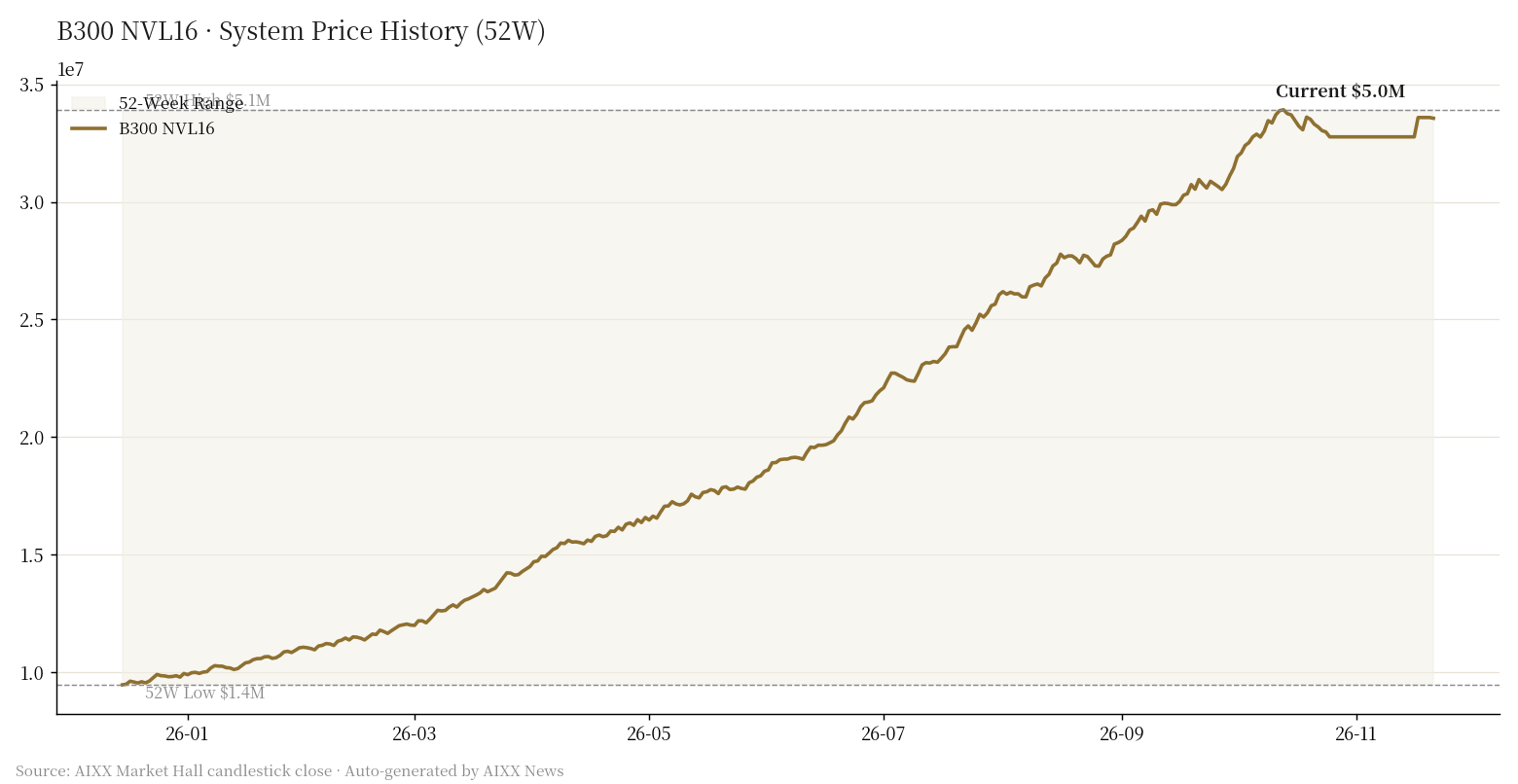
52-week range band + current price trend · click for lossless full-size image
Editor's Take
B300 NVL16 is quoted at $5.0M this period, up 2.7% over 7 days and 1.9% over 30 days, with a 52-week percentile as high as 98 — the price is running nearly flush against its yearly ceiling. The current level is just 1.3% below the 52-week high of $5.1M and has yet to set a new high, in a state of 'sideways consolidation ahead of the high.' Short-term upward momentum remains intact, but the room left for chasing gains is extremely narrow.
Viewed over the 52-week range, the asset has climbed steadily from its low of $1.4M and now stands 72% above the high-water mark reference — that is, the current price is roughly 3.6 times the yearly low. This positioning structure means the rally has already realized the vast majority of its gains, and the 98th percentile is itself the market's strongest annotation: nearly every buy point this year sits below the current price. Whether the 1.3% gap to the high can be filled is the most direct bull-bear litmus test going forward.
Within the Blackwell Rack Family, B300 NVL16's 7-day gain of +2.7% belongs to the leading tier: over the same period, GB200 NVL72 led with a 3.9% gain, while GB300 NVL72 fell 2.5% and B200 HGX 8-GPU slipped 0.4%, showing clear divergence within the family. In terms of price magnitude, it quotes $5.0M , sitting between the air-cooled unit B300 NVL8 ($3.1M ) and the full-rack-tier DGX GB300/GB300 NVL72 (both $23.9M ), making it the key tier in the family for mid-to-large compute demand, with its weekly gain notably faster than the smaller B300 NVL8 (+0.2%) and desktop-grade DGX Station GB300 (+0.8%).
The supply-side structure warrants attention: there are currently 2,793 open listings with a median listing price of $442K , only about one-eleventh of the index price. This enormous spread multiple indicates a typical long-tail distribution in market listings — a large volume of low-priced listings concentrated far below the index, while the index is supported by the high-price trading range at the top. In other words, there is a significant disconnect between the elevated spot index and the price expectations embodied in the bulk of listings; the supply side's genuine willingness to absorb demand is not at the same level as the index price.